
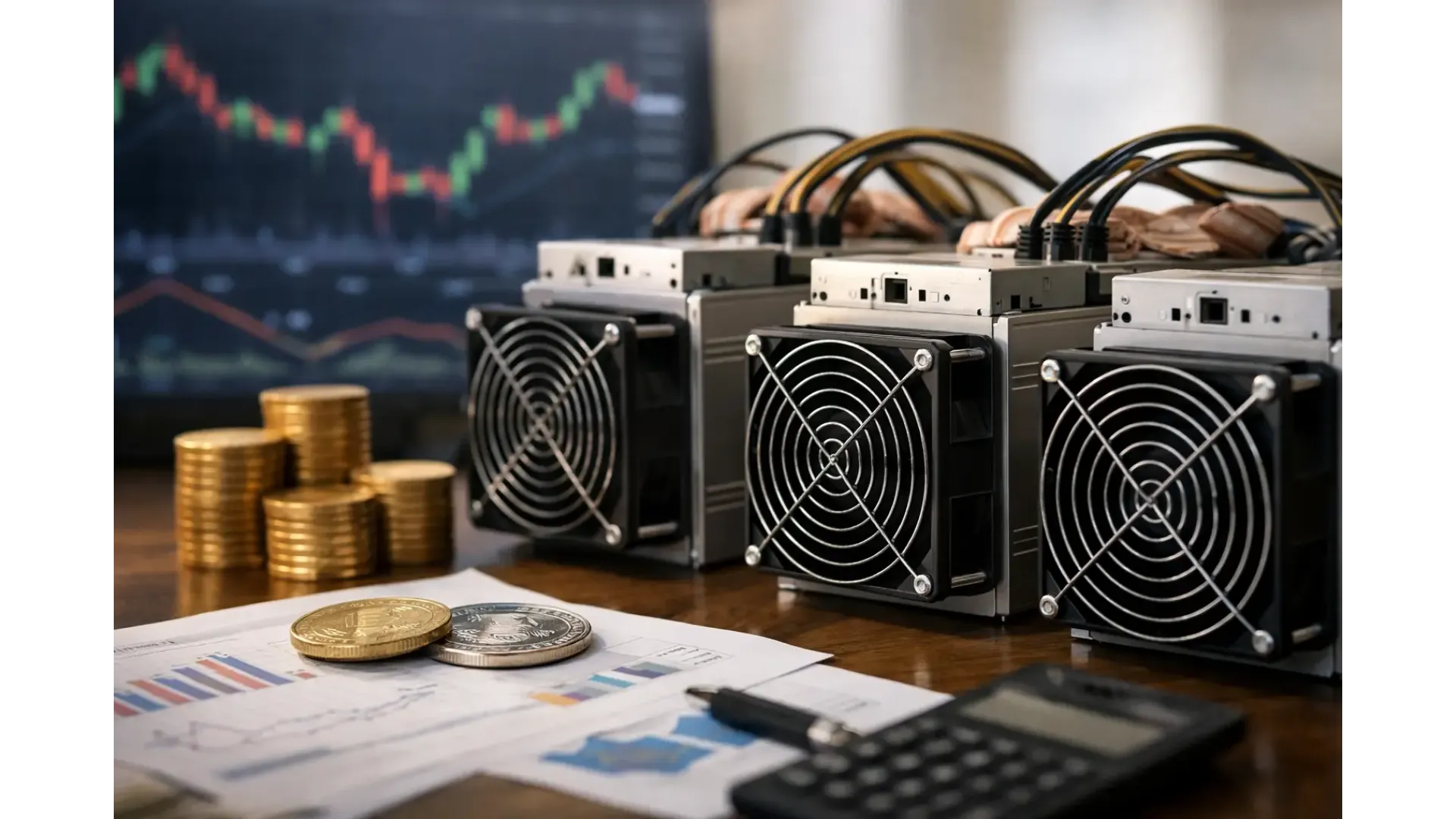
A miner that looks profitable on a product page can turn marginal the moment it lands in your setup. That is the core issue with ASIC miners' profitability. The machine matters, but the result depends just as much on electricity price, efficiency, network conditions, noise limits, cooling, and how long you expect the unit to stay competitive.
For buyers comparing hardware, the useful question is not simply whether an ASIC can mine Bitcoin. It is whether that machine can produce an acceptable return in your specific environment. A home miner on a standard UK tariff faces a very different calculation from a small operator with lower power costs and a dedicated ventilated space.
What drives ASIC miners' profitability
The biggest variable is usually electricity. ASIC miners convert electrical power into hashrate, and every watt has a cost. Two machines with similar hashrate can produce very different outcomes if one is materially more efficient. That is why joules per terahash matters as much as raw terahash.
Bitcoin network difficulty is the next major factor. As more hashrate joins the network, the amount of Bitcoin earned by an individual miner for the same performance tends to fall. A machine that performs well today may earn less a few months later even if your local costs stay unchanged.
Then there is the Bitcoin price itself. Higher BTC prices can improve revenue when measured in pounds, while a drop can compress margins quickly. Profitability is never fixed. It moves with the market, with network competition, and with your operating costs.
Pool fees, downtime, and power quality also matter more than many first-time buyers expect. A miner that is offline for part of the day is not just underperforming - it is often still carrying the same fixed capital cost. Likewise, unstable power or poor ventilation can reduce efficiency, shorten hardware life, or increase maintenance needs.
ASIC miners' profitability starts with the right maths
The basic calculation is straightforward. Start with expected daily mining revenue, then subtract daily electricity cost and any pool fees. That gives you operating profit before considering the purchase price of the machine, accessories, import or delivery costs where relevant, and any maintenance or replacement parts over time.
For electricity cost, multiply the miner's power draw in kilowatts by your tariff and by the number of hours run. A 3,000W unit running continuously uses 3kW per hour. Over 24 hours, that is 72kWh per day. At a tariff of £0.25 per kWh, you are spending £18 per day on power before you consider anything else.
That is why nameplate hashrate alone is not enough. A machine may advertise strong output, but if the power draw is high relative to the hashrate, the margin can narrow quickly. In a higher-cost electricity market, efficiency is often the difference between a workable setup and a machine that is hard to justify.
Capital recovery matters as well. If you buy a machine for £2,500 and it generates £4 per day after electricity, the simple payback period looks very different from a machine generating £10 per day after electricity. Neither figure should be treated as guaranteed because network difficulty and BTC price can change, but the comparison is still useful when screening options.
Why efficiency often matters more than peak hashrate
For many buyers, the instinct is to chase the highest terahash they can afford. That can work if power is cheap and space is built for industrial operation. For home and small-scale setups, efficiency tends to be the more reliable filter.
A more efficient miner gives you more flexibility. It can remain viable for longer if network difficulty rises. It can cope better with periods when Bitcoin price softens. It may also reduce strain on your electrical setup and cooling requirements, both of which affect the real cost of operation.
This is especially relevant for UK buyers. Domestic electricity rates are rarely forgiving, and noise or heat can become a practical limit well before theoretical profitability is reached. A machine that is acceptable in a garage, outbuilding, or dedicated workshop may be unrealistic in a shared home environment. Profitability on paper is not much use if the system cannot run consistently where you plan to place it.
The hidden costs that change the picture
When comparing ASIC miners' profitability, buyers often focus on machine price and estimated revenue. That is reasonable, but incomplete.
Heat management adds cost. High-performance ASICs produce substantial heat, and removing it safely may require additional fans, ducting, or other changes to your space. Noise management is another issue. Some units are simply too loud for domestic settings without mitigation.
Electrical infrastructure can also become a bottleneck. You may need the correct power supply, suitable sockets, and enough circuit capacity to run the miner safely. If the installation needs adjustment, that expense should be included in your payback thinking from the start.
There is also the question of hardware ageing. Newer ASICs usually offer better efficiency than older generations. That means a cheaper pre-owned unit may lower upfront spend but can still be the weaker long-term choice if it consumes too much power for the hashrate delivered. On the other hand, pre-owned hardware can make sense for buyers with low electricity costs, specific use cases, or a shorter investment horizon. It depends on the numbers, not just the sticker price.
Home mining versus small-scale dedicated setups
Home mining has a different profitability profile from a more controlled small-scale setup. At home, power tariffs are often higher, ventilation is more limited, and noise tolerance is lower. Those factors push buyers towards compact or lower-power equipment, even if the absolute return is smaller.
A dedicated setup can improve the picture if it has better airflow, stable power, and room for efficient operation. Even then, the same principle applies: the hardware must fit the environment. An oversized machine in the wrong space tends to create extra cost and downtime.
This is one reason specialist retailers matter in this market. Buyers are not just choosing a hash rate figure. They are matching a miner to a budget, a power limit, a space constraint, and a support expectation. Ehasher focuses on that practical side of the purchase, which is often where poor buying decisions can be avoided.
How to compare machines without relying on hype
The cleanest way to compare options is to look at four things together: hashrate, power draw, efficiency, and total acquisition cost. Ignore marketing language and reduce each machine to those numbers first.
Then test a few realistic scenarios. Use your actual electricity tariff, not an idealised one. Consider what happens if network difficulty rises or if BTC price falls. If a machine only looks attractive under perfect conditions, that is a warning sign.
It also helps to separate short-term cash flow from long-term resilience. A machine with stronger current revenue but weaker efficiency may look appealing today, while a slightly more expensive efficient unit may hold up better over time. Neither is automatically right. The choice depends on whether you prioritise immediate output, lower operating risk, or a balance of both.
When ASIC miners' profitability is still worth pursuing
Mining does not need to be risk-free to be rational. Many buyers are not expecting guaranteed returns. They want exposure to Bitcoin production, direct control over hardware, and a setup that fits their budget and operating conditions.
That is why the best purchase is not always the most powerful unit available. It is the one that you can run consistently, power affordably, and support properly. For some buyers that means a full ASIC system. For others it means starting smaller, testing the environment, and expanding only once the real operating profile is clear.
If you approach the numbers honestly, ASIC miners' profitability becomes much easier to judge. Start with power cost, insist on efficiency, account for heat and noise, and be realistic about network changes. A miner should fit your site and your tariff before it fits your ambition. That is usually where better decisions begin.