
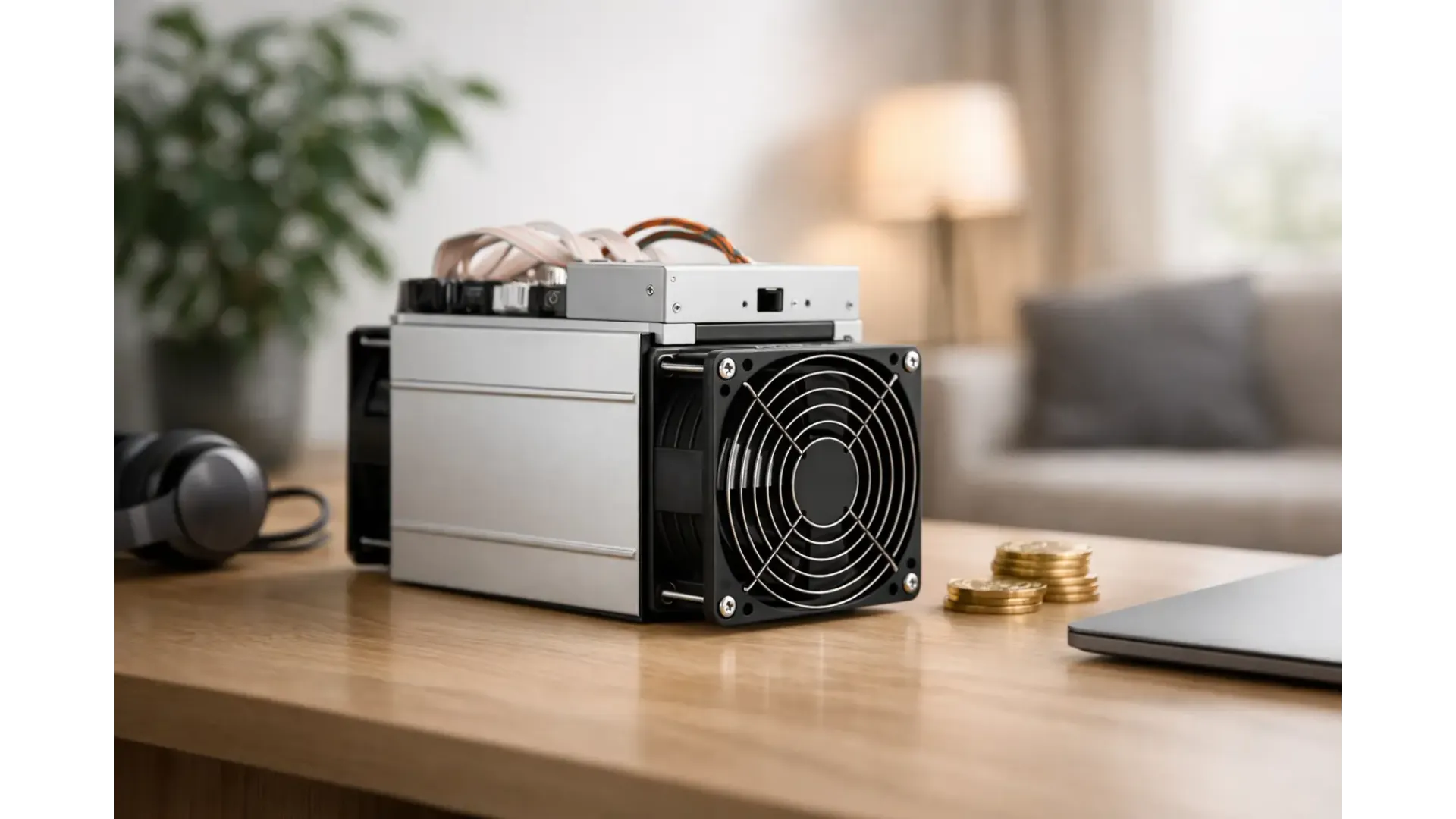
A miner rated at 75 dB on paper does not sound dramatic until it is running in a spare room for twelve hours. That is usually the point where buyers start looking seriously at quiet asic miner options, not because silence is possible, but because noise tolerance at home is very different from noise tolerance in a garage, workshop or farm.
If you are buying for a domestic setup, the right question is not simply which ASIC is quietest. The better question is which machine is quiet enough for your space, power limits and mining goals without creating a heat and ventilation problem that is worse than the original noise issue. With ASICs, lower sound output nearly always comes with trade-offs in hashrate, cooling design, efficiency or cost.
What “quiet” means with ASIC miners
Most standard ASIC miners are not designed for living areas. Traditional air-cooled units use high-speed fans to move a large volume of air across dense heatsinks, and that creates the familiar turbine-like sound many miners know too well. In practical terms, a typical full-size ASIC can be far too loud for a home office, bedroom or shared room.
That is why quiet ASIC miner options tend to fall into three broad groups. The first is low-power, home-oriented miners built specifically for quieter operation. The second is standard ASIC hardware modified with alternative cooling or sound reduction measures. The third is enclosed or immersion-based setups where the miner itself is not inherently quiet, but the installation is designed to control sound more effectively.
For most home users, the first group is the most realistic. It offers lower noise, simpler setup and fewer risks. The trade-off is obvious - lower hashrate and, in many cases, a different return profile from industrial ASIC hardware.
Quiet ASIC miner options that make sense at home
Home-friendly ASICs are usually compact, lower wattage and engineered for desk, shelf or small-room use rather than rack deployment. These machines are popular with hobby miners, solo mining enthusiasts and buyers who want dedicated Bitcoin hardware without the acoustic footprint of a farm unit.
A quiet unit often relies on one large slow-spinning fan, a smaller power envelope, or a chassis built around reduced airflow demand. This keeps noise down, but it also caps the amount of heat the machine can move. That is one reason why quieter miners are rarely direct substitutes for large high-performance models.
If your goal is learning, lottery-style solo mining, running a node-connected device, or maintaining a small home setup without upsetting everyone else in the house, these quieter products can be the right fit. If your goal is maximum hashrate per square metre, they are usually not.
Low-power solo and hobby miners
This is often the most practical entry point. Compact ASIC devices aimed at solo mining or hobby use are among the best quiet asic miner options because they are designed around domestic constraints from the start. They generally draw far less power than full-size machines, produce less heat and can run in spaces where a standard ASIC would be unworkable.
The expectation needs to be realistic. These devices are usually bought for accessibility, low setup friction and home compatibility rather than aggressive production targets. For many buyers, that is exactly the point. A quieter miner that can stay online consistently at home is more useful than a louder machine that gets switched off because it is unbearable.
Boxed and silenced ASIC setups
Some miners choose a full ASIC unit with a sound-reduction enclosure. This can work, but it requires care. You are not removing the heat load, only changing how noise and airflow are managed. A poorly designed box can choke cooling, increase internal temperatures and shorten hardware life.
A properly engineered silenced setup can reduce perceived noise significantly, especially when matched with ducting and controlled exhaust. The downside is complexity, added cost and a larger physical footprint. It suits technically confident users more than first-time buyers.
Hydro and immersion-style approaches
Liquid-assisted cooling can reduce fan noise, but this is not a simple home shortcut. Hydro units still require supporting infrastructure, and immersion setups introduce another layer of equipment, maintenance and cost. They can be effective for experienced operators pursuing quieter high-performance mining, but they are not usually the easiest path for a domestic buyer who wants a straightforward install.
For most households, a purpose-built quieter miner is easier to live with than converting a large machine into something more tolerable.
Noise is only part of the buying decision
A miner that sounds acceptable for ten minutes can still become irritating over a full day, particularly if the tone is high-pitched. Fan character matters as much as the dB figure. Lower-frequency airflow noise is generally easier to tolerate than a sharp whine, even if the measured sound level looks similar.
Heat is the next issue. Quieter miners often seem more manageable because they are less acoustically aggressive, but every watt consumed still turns into heat. In a small UK room, that can build quickly. During colder months, some buyers do not mind the extra warmth. In summer, the same setup may become difficult to run continuously.
Power draw also affects placement. A lower-wattage miner is easier to use on standard household circuits and generally easier to vent. That is one reason small home ASICs remain attractive despite lower output. They fit real domestic limits better.
How to compare quiet asic miner options properly
Start with your room, not the specification sheet. A detached outbuilding, loft, utility room and home office all have different tolerances for sound, airflow and ambient temperature. The same miner can be perfectly acceptable in one setting and completely unsuitable in another.
Then look at the whole operating profile: noise level, fan design, power draw, heat output, expected runtime and the level of tinkering required. Some buyers are comfortable modifying firmware, adjusting fan curves and building ducted exhaust paths. Others want a machine that arrives ready to use with minimal intervention. There is no universal best choice here.
It also helps to separate commercial mining expectations from home mining expectations. A quiet home-oriented ASIC should be judged on suitability, reliability and practicality, not against the raw performance of warehouse-class machines. Those are different product categories solving different problems.
Questions worth asking before you buy
If you are weighing up home mining hardware, ask yourself whether the machine can run where you actually intend to place it, whether the heat can be exhausted safely, and whether the noise will still be acceptable overnight or during work hours. Also consider whether you want an entry-level device for learning and hobby use, or a more serious machine that will need supporting infrastructure.
Buyers in the UK should also think about supply quality, plug compatibility, delivery times and after-sales support. Specialist retailers such as Ehasher are useful here because the difference between a workable home setup and a frustrating one often comes down to correct hardware pairing and realistic expectations at the point of purchase.
The common mistake with quiet miners
The most common mistake is chasing the highest hashrate available and trying to make it quiet afterwards. That usually leads to extra spending on fan swaps, boxes, ducting or cooling experiments, with mixed results. A miner chosen for domestic use should be selected around domestic constraints first.
Another mistake is underestimating cumulative noise. One compact miner may be fine. Two or three units in the same room can change the picture completely. The same applies to heat. Small setups scale less neatly than buyers expect.
There is also a maintenance angle. Dust control, filter cleaning and airflow checks matter more when you are trying to keep a miner quiet, because reduced cooling margin leaves less room for neglect. A quieter machine still needs proper ventilation and routine attention.
Which type of buyer should choose which type of machine?
If you are new to ASIC mining and want a simple, home-compatible setup, a low-power dedicated miner is usually the safest option. It keeps noise and power demands within a more realistic range and reduces the risk of buying something that cannot be used comfortably.
If you already understand thermal management and are prepared to build around the hardware, a larger ASIC with sound control measures may be viable. It can deliver higher output, but only if you are willing to manage the complexity that comes with it.
If your priority is the best acoustic result possible, it often makes more sense to lower your performance target and choose hardware built for quieter operation from the start. That is less glamorous than forcing a datacentre-style miner into a spare room, but it is usually the more dependable decision.
The practical approach is to treat quiet as a range, not a promise. The best quiet asic miner options are the ones that match your room, your tolerance for noise, your power availability and the amount of setup work you are willing to do. A miner you can run consistently is almost always better than one that looks impressive on a product page but does not suit the space you have.